The algorithmic Bar: why hiring 'good' Data Scientist is liability in 2026
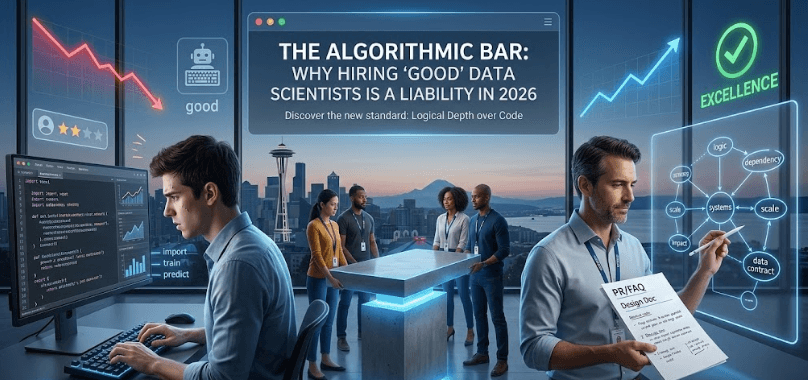
In an era where GenAI can write code in seconds, the 'Bar' for technical talent has shifted. Discover why hiring merely 'good' Data Scientist is a liability and how Amazon's Bar Raiser mechanism protects long-term engineering maturity.
Discover why the ability to write code is no longer the gold standard for excellence. Learn how to evaluate "logical depth" to build teams that truly elevate your organization's technical DNA.
Landing my current role as a Senior Data Scientist was anything but a straight line. It was a grueling gauntlet of interviews, endless hours of prep that felt like they'd never end, and a fair share of anxiety that kept me up at night. But looking back from my desk in Seattle, the single biggest takeaway wasn't a technical breakthrough or a new model architecture; it was realizing that in high-stakes engineering, the "bar" isn't measured by what you can do, it's measured by how you think while you're doing it.
In 2026, we're living in a paradox. GenAI can spit out boilerplate code, optimize complex SQL queries, and structure Machine Learning models in a heartbeat. If your hiring standard is still focused on finding someone who can just "execute models" or "churn out code", you're taking a massive systemic risk. Hiring someone who is merely "good" isn't enough anymore. Today, if your talent doesn't scale, your systems will die under the weight of their own mediocrity.
1. The anatomy of logic: moving beyond syntax
During my own interview process, the stage that left the deepest mark on me was the Live Coding session. It wasn't just about solving a complex algorithmic puzzle in front of an expert; it was a high-pressure exercise in mental transparency.
- Real-Time reasoning: my interview wasn't looking for prefect syntax; they wanted to understand the "why" behind every single keystroke. While I was developing the solution, I had to explain why I chose a specific data structure over another, and how that choice would impact system latency in a production environment.
- The "correct result" trap: a common mistake I see with junior developers is thinking that if the code runs and the test passes, the job is done. For a senior architect, the result is only 30% of the value; the other 70% is the ability to defend the architecture of that solution and predict where it will break when the data volume hits 1,000x.
- Engineering maturity: you stop being a "ticket-taker" the moment you start acting like an architect who understands data contracts and system dependencies. There is a world of difference between writing a function that works today and designing a component that remains maintainable for the next decade.
2. The "Bar Raiser" in the GenAI era
At Amazon, and now in my own ventures like Nordata.AI, we lean heavily on the Bar Raiser mechanism. This process ensures we aren't just hiring to fill a seat out of urgency, but hiring for long-term excellence.
- Raising the average: the goal of every hiring loop isn't just to fill a gap; it's to ensure the new hire is objectively better than 50% of the people currently in that role. If they aren't raising the bar, they are a risk to the team's scalability.
- Multi-dimensional evaluation: my own journey required me to prove mastery not just in code, but in cloud infrastructure, LLMs, and large-scale GenAI systems. In 2026, a Data Scientist who doesn't understand the infrastructure where their model lives is a liability, not an asset.
- The power of the veto: the bar raiser is an objective voice from outside the immediate team whose job is to protect the company's technical DNA. Their authority to veto a hire ensures that we never compromise our standards just to hit a deadline.
3. Critical thinking as your primary asset
Today, the true competitive advantage for a Senior Data Scientist is the ability to navigate uncertainty through what I call a "structured pause". During my two-month onboarding, I realized that operating at scale requires an almost obsessive discipline for up-front design.
- Impact-driven design: before we touch a single line of code, we have to be able to write a design document that maps out the data flow, the expected impact, and the success metrics. If you can't define the value of your project on one page, you aren't ready to start programming.
- Architectural communication: ultimately, your software architecture is a mirror of your communication architecture. If a candidate can't articulate their logic clearly and structurally, they won't be able to build systems that others can maintain or evolve.
💡 Pro-tips for evaluating the "bar" in your team
Whether you're leading an engineering org or building your own startup, I suggest implementing these "rigor mechanisms" I use every day at Latent Insights:
- Adopt "explain-as-you-go": in technical assessments, weigh the explanation of the logic far more heavily than the actual code output. Code can be refactored by AI; flawed logic cannot.
- Test for systems thinking: ask candidates how their model would interact with systems that don't even exist yet, or how it would scale if data volume spiked 10x overnight. 3 Don't overlook "technical soft skills": the ability to write a crisp PR/FAQ or a one-page design doc is just as critical as knowing how to train a model. An engineer who can't write is a bottleneck for the entire organization.
Technical excellence isn't an act; it's a habit of thought. Don't lower the bar because you're in a hurry; the cost of technical mediocrity is a debt you'll eventually pay back with interest your company can't afford.